
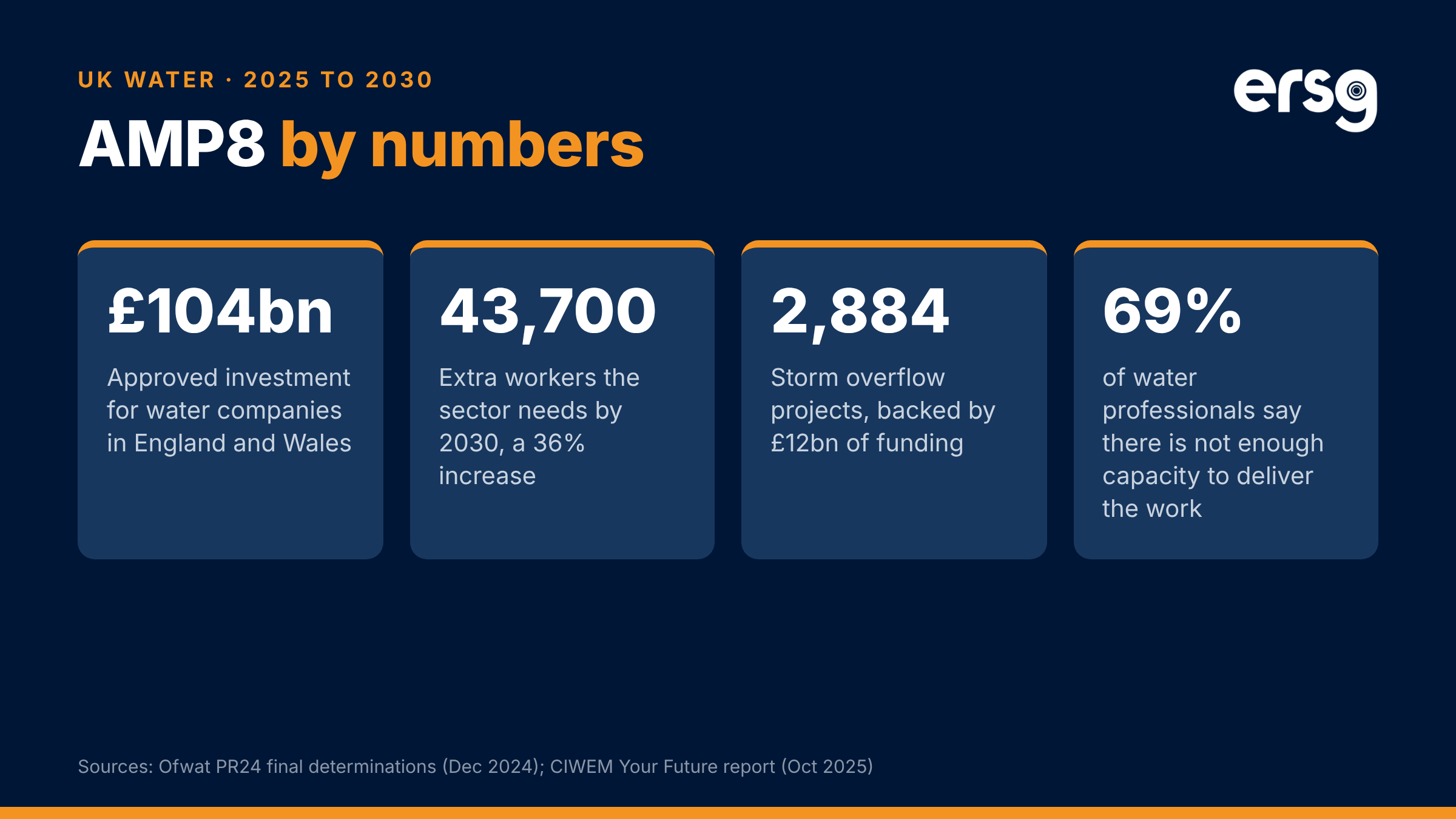
AMP8 is the biggest investment programme the UK water sector has ever seen. Ofwat has approved £104bn of spending for water companies in England and Wales between 2025 and 2030, and the industry needs about 43,700 extra workers by 2030 to deliver it. The pressure will be hardest in seven roles: MEICA engineers, commissioning engineers, process engineers, hydraulic modellers, planners and project controls, quantity surveyors, and site managers.
What is AMP8?
AMP8 (Asset Management Period 8) is the five-year investment period for water companies in England and Wales. It runs from April 2025 to March 2030. Ofwat's final determinations, published in December 2024, set out what the money pays for.
The largest commitments are £12bn for 2,884 storm overflow projects, which aim to cut spills by 45% from 2021 levels by 2030, and £6bn to reduce nutrient pollution at around 1,000 sites. A further £2bn of early funding will unlock £50bn for 30 major projects, including nine new reservoirs and nine large water transfer schemes, and 8,445km of water mains will be replaced.
Investment is roughly four times what it was before. Nearly 90% of it responds to new legal requirements, so it cannot simply be pushed back.
Why the workforce is the bottleneck
The money has been approved. The people to spend it have not been found. CIWEM's 2025 Your Future report found the sector needs 43,700 more workers by 2030, a 36% increase. In the same report, 69% of water professionals said the industry lacks the capacity to do all the work it has committed to.
Contractors are saying the same. JN Bentley has named talent and capacity as a main strategic risk, and expects resourcing pressure in some specialisms and regions as schemes move from planning into delivery.
These are the seven roles we expect to be hardest to fill.
Engineering and design
MEICA engineers design, install and maintain the equipment that makes a treatment works run: pumps, motors, control panels and telemetry. Nearly every storm overflow, nutrient removal and treatment upgrade scheme in AMP8 needs MEICA input, and water companies are competing with energy, data centre and manufacturing projects for the same people.

Process engineers:
Decide how a works treats water and wastewater. The £6bn spent on nutrient pollution means upgrading treatment processes, mostly to remove phosphorus and nitrogen. There are few process engineers, and both consultancies and contractors need them early, at design stage.
Hydraulic modellers:
Work out how a sewer network behaves in heavy rain before a storm overflow can be fixed. With 2,884 storm overflow projects in the programme, they are needed at the very start of each scheme, and every month of delay in modelling pushes back the construction that follows.

Delivery and commercial
Planners and project controls specialists keep a programme of this size on track through accurate schedules, cost tracking and risk management. They are in demand across water, energy and transport at the same time. Many water companies now deliver through large alliances and frameworks, which need strong programme controls to report progress back to Ofwat.
Quantity surveyors and commercial managers matter more than ever, with investment roughly four times higher and bills rising to pay for it. Ofwat can return unspent investment money to customers, so every pound has to be tracked. Quantity surveyors with experience of water frameworks and NEC contracts can expect plenty of offers.
Site, construction and project managers run the work on pipelines, reservoirs, mains replacement and treatment upgrades. People who can deliver safely in live water environments will be in short supply, especially as the larger reservoir and transfer schemes move into construction.
Testing and commissioning
Commissioning engineers and leads test, prove and hand over every new asset before it counts towards a company's targets. Commissioning comes at the end of a project, so demand builds as AMP8 schemes reach completion from 2027 onwards. Experienced commissioning leads who know water treatment processes are scarce, and they are often booked well in advance.
How to stay ahead
Plan hiring around the programme, recruiting 6 to 12 months before a scheme's peak rather than when it starts. Look across sectors, because MEICA, commissioning and project controls skills transfer well from energy and infrastructure. Use contract and permanent hiring together, so contractors cover peak demand while a permanent team is built. And keep teams moving, redeploying good people from finished schemes onto new ones rather than losing them to the market.